






For many parents, bringing their child to a first occupational therapy session comes with a mix of hope and uncertainty. Hope because they are finally getting professional help for something they have been worried about. Uncertainty because they are not entirely sure what occupational therapy involves, what the therapist will do with their child, or what to expect when they walk through the door.
This guide walks through exactly what happens at a first OT session, what the therapist is looking for, what questions you will be asked, and what the session leads to. Understanding the process in advance reduces anxiety for both parent and child, and often makes the session itself go more smoothly.
Before the Session: What to Prepare
Most occupational therapy centres, including 7 Senses, will ask you to complete some information before the first session. This typically includes a developmental history form covering milestones, medical history, any previous diagnoses, school reports, and descriptions of the specific difficulties you are seeing at home.
Take this seriously. The more specific and detailed your responses, the better the therapist can plan the session. Phrases like “struggles with daily activities” are less useful than “cannot manage buttons or zips independently, avoids touching play dough or sand, and has daily meltdowns when getting dressed.”
If your child has any previous assessment reports, school reports, or letters from paediatricians, bring copies. The therapist will want to know what has already been observed and assessed.
When You Arrive: The First Few Minutes
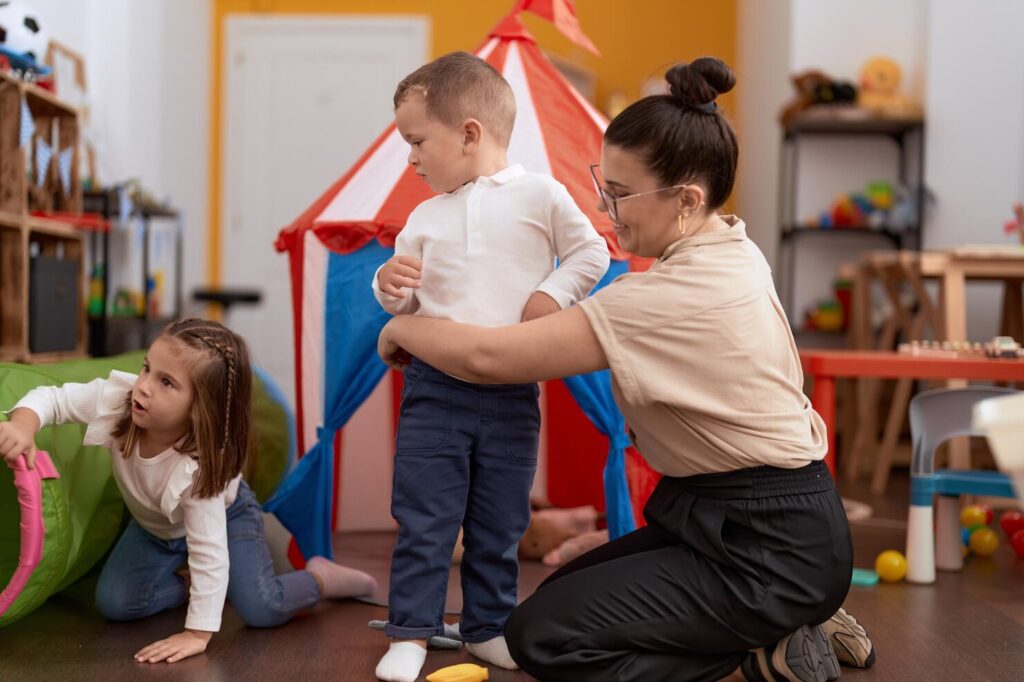
The therapist will take time to welcome your child into the space before beginning any formal observation. For young children especially, the first few minutes are about building comfort rather than assessment. The therapist may offer the child some toys to explore, observe how they move around the room, and watch how they interact with you.
This initial observation period is already therapeutic data. The therapist is watching how the child enters an unfamiliar environment, how they respond to a new adult, whether they seek you out for reassurance, how they choose to interact with objects in the room, and whether their movement and posture look typical.
Try to let your child explore without guiding them. The therapist needs to see what the child does naturally, not what you prompt them to do.
At 7 Senses in Ahmedabad, we make the first session as comfortable as possible for both children and parents.
We explain everything we are doing as we go, involve you throughout, and make sure you leave with a clear understanding of what we found and what the next steps are.
Book your child’s first OT session today. Get in touch here.
The Parent Interview
While younger children play in the room, the therapist will conduct a parent interview. This is a structured conversation covering:
- Developmental history: When the child reached major milestones, whether any milestones were delayed, and whether there was any regression.
- Daily functioning: What a typical day looks like. Specifically: how does the child manage dressing, eating, bathing, and personal hygiene? What is the morning routine like? What does bedtime look like?
- Play and social skills: How does the child play? Do they play with other children? What is the quality of their social engagement?
- Sensory responses: How does the child respond to textures, sounds, movement, touch, and food? Are there specific triggers that consistently cause distress?
- School or nursery: How does the child manage in a structured group setting? What have teachers observed? Are there any concerns from school?
- Your main concerns: What brought you here today? What are you most worried about or hoping to address?
Be honest and specific. Therapists hear a wide range of presentations and are not there to judge your parenting. The more accurately you describe what you are seeing, the more useful the session will be.
What the Therapist Is Assessing
Depending on your child’s age and the reasons for the referral, the therapist will observe or directly assess some combination of the following areas during the first session.
Fine motor skills
How the child picks up small objects, how they hold a pencil or crayon, whether they use both hands together in a coordinated way, and how they manage tasks requiring precision. The therapist may offer puzzles, drawing activities, or small objects to manipulate.
Gross motor skills and postural control
How the child moves around the room, whether they can balance on one foot, how they manage stairs, whether they slump or maintain an upright posture during seated activities. The therapist watches gait, coordination, and body awareness.
Sensory processing
How the child responds to sensory input in the room. The therapist may offer different textures, observe the child’s response to movement equipment, note whether they seek or avoid certain inputs, and ask targeted questions based on what they observe.
Self-care skills
Based on the parent interview, the therapist may directly observe or ask the child to demonstrate specific self-care tasks if appropriate. They may also assess readiness skills for tasks the child has not yet attempted.
Play skills
The quality of the child’s play: whether it is age-appropriate, varied, imaginative, and social or solitary and repetitive. Play is a window into multiple areas of development simultaneously.
Attention and self-regulation
How long the child can sustain engagement with an activity, how they transition between tasks, whether they can follow simple instructions, and how they manage frustration during the session.
Standardised Assessment Tools
In addition to clinical observation, the therapist may use standardised assessment tools. These are tests that have been developed and normed on large groups of children so that an individual child’s performance can be compared to age expectations.
Common tools used in paediatric OT include the Bruininks-Oseretsky Test of Motor Proficiency (BOT-2) for motor skills, the Sensory Processing Measure (SPM) or Sensory Profile for sensory processing, and the Vineland Adaptive Behaviour Scales for daily living skills. Not all will be used in every first session. The therapist selects tools based on the specific concerns raised.
Standardised assessments are not tests the child can pass or fail. They are measurement tools that give the therapist objective data about where the child is relative to age norms.
What the First Session Does Not Include
It is worth knowing that the first session is almost entirely assessment, not treatment. The therapist is gathering information. They are not yet providing intervention. This can sometimes feel frustrating for parents who have been waiting for help, but a thorough assessment is genuinely necessary before meaningful therapy can begin.
The first session also does not include a diagnosis. An OT assessment produces a functional profile of the child’s strengths and difficulties. A formal diagnosis of autism, ADHD, or another condition requires a medical or psychological assessment. The OT findings contribute to this picture but are not a diagnosis in themselves.
At the End of the First Session
The therapist will share initial observations with you. These are typically preliminary findings rather than a complete assessment report, which may take a few days to prepare. They will explain what they observed, what areas they think need further assessment or direct intervention, and what the likely next steps are.
You should leave the first session with:
- A clear sense of what the therapist observed and what areas they are focused on
- An understanding of what the next steps are and what the therapy plan will look like
- Some initial suggestions for what you can do at home in the meantime
- A timeline for when the full written assessment report will be available
- An opportunity to ask questions
If you leave a first session without these things, ask for them. A good therapist will provide clear communication as a matter of course. Our article on top signs your child may need paediatric occupational therapy may help you reflect on what you observed in the session against the areas the therapist was looking at.
How to Prepare Your Child for the First Session
- Keep it simple: Tell your child they are going to meet someone who helps children with activities like drawing, playing, and dressing. Avoid framing it as going to a doctor unless your child is comfortable with that.
- Do not over-prepare: Some parents rehearse activities with their child before the session, hoping to show the therapist the child’s best performance. This is counterproductive. The therapist needs to see a realistic picture of the child’s typical functioning.
- Bring comfort items: If your child has a comfort toy, dummy, or security object, bring it. The aim is for the child to feel as comfortable as possible in an unfamiliar environment.
- Plan for after the session: Some children are tired, overstimulated, or emotionally flat after a first assessment session. Plan a quiet, low-demand activity for afterwards rather than going somewhere busy.
Frequently Asked Questions
Q: How long does a first OT session usually last?
A first assessment session typically lasts 60 to 90 minutes. This includes the parent interview, the child assessment, and the initial feedback discussion. Some centres conduct the assessment over two shorter sessions, particularly for very young or anxious children.
Q: Should I stay in the room during the session?
For young children, parents are usually present throughout the session. For older children, the therapist may ask the parent to step out at some point to observe whether the child’s behaviour changes without the parent present. Follow the therapist’s guidance on this.
Q: What if my child refuses to engage with the therapist?
This is common, particularly for anxious or sensory-avoidant children. A skilled paediatric therapist is experienced in engaging reluctant children and will not force participation. The child’s resistance to engagement is itself informative data. Do not worry that the session is wasted if your child does not cooperate fully.
Q: How soon will therapy begin after the first session?
This varies by centre and demand. At 7 Senses, we aim to begin therapy as soon as possible after the assessment, typically within one to two weeks. We will also provide initial home strategies immediately after the first session so that the wait does not mean nothing is happening.
Q: Can the first OT session be done online?
A comprehensive in-person assessment is always preferable for a first OT session because the therapist needs to observe the child in a physical environment with equipment. However, for families outside Ahmedabad, our online consultation service can provide initial guidance and help determine whether an in-person assessment is needed.
Conclusion
A first occupational therapy session is primarily an assessment. Its purpose is to give the therapist a thorough, accurate picture of your child’s functional profile before therapy begins. Coming prepared, being specific about what you are observing, and letting your child engage naturally will make the session as productive as possible.
If you are ready to book a first OT session for your child in Ahmedabad, contact 7 Senses. We will walk you through the process and make sure you and your child know what to expect from the moment you arrive.