






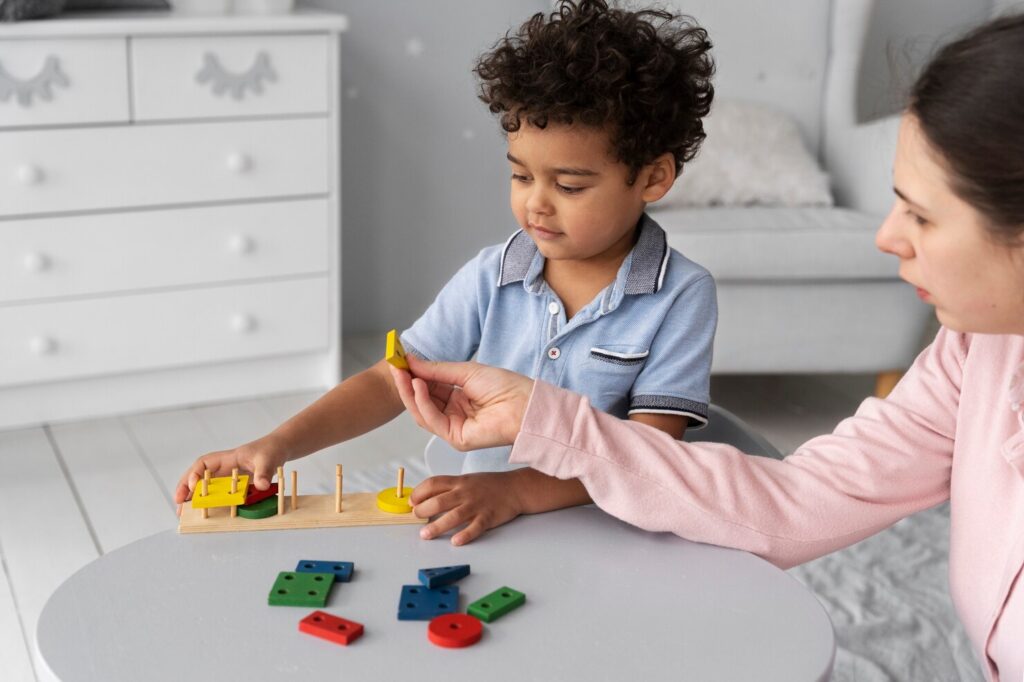
When a child is diagnosed with autism or a developmental delay, parents are often told they need both ABA therapy and occupational therapy. Most parents nod and agree without fully understanding what each one actually does or why both are being recommended.
The confusion is understandable. Both therapies involve working with children on skills and behaviour. Both happen in clinic settings. Both require consistent home follow-through. But they are addressing fundamentally different things, and understanding the difference helps parents be more effective partners in their child’s progress.
What Is ABA Therapy?
ABA stands for Applied Behaviour Analysis. It is a structured, evidence-based approach that uses the science of learning and behaviour to build skills and reduce behaviours that interfere with a child’s development and daily functioning. It is most commonly used with autistic children but is applicable to any child whose learning or behaviour is significantly affected by developmental differences.
ABA works by identifying specific skills a child needs to develop, breaking them into small teachable steps, and using reinforcement to build those skills systematically. The focus is on communication, social interaction, learning readiness, self-care, and behaviour management. For a complete overview of how ABA works in practice, our guide on ABA therapy in Ahmedabad covers the process from assessment to session to home practice.
What Is Occupational Therapy?
Occupational therapy focuses on the practical skills children need to function in everyday life. The word occupational refers to the meaningful activities that are central to a child’s day: dressing, eating, writing, playing, and managing their sensory environment. OT addresses the functional and sensory barriers that prevent a child from participating in these activities independently.
For autistic children specifically, OT plays a significant role in addressing sensory processing differences, building fine motor skills, developing self-care routines, and improving the regulation that underpins all other learning. Our detailed article on occupational therapy for autism explains how OT is specifically adapted for autistic children.
Many families spend months on the wrong combination of therapies because no one clearly explained the difference at the start.
A multidisciplinary assessment at 7 Senses maps out exactly which therapies your child needs, in what order, and how they work together.
Book an assessment with our team in Ahmedabad. Contact us here.
ABA Therapy vs Occupational Therapy: The Core Difference
The simplest way to understand the difference is through the question each therapy is trying to answer.
ABA therapy asks: what behaviours and skills does this child need to develop, and how do we teach them systematically?
Occupational therapy asks: what functional tasks is this child struggling with, what is getting in the way, and how do we remove those barriers?
ABA operates through structured teaching, reinforcement, and data-driven adjustment of programmes. OT operates through activity-based intervention, sensory work, and building the underlying capabilities that functional independence requires.
What Each Therapy Focuses On
ABA therapy focuses on
- Communication skills, including requesting, labelling, and conversation
- Social skills, including eye contact, turn-taking, and reading social cues
- Learning readiness, including sitting, attending, and following instructions
- Reducing behaviours that interfere with learning or safety
- Self-care tasks approached through behavioural teaching sequences
- Generalising skills across different settings, people, and environments
Occupational therapy focuses on
- Sensory processing and regulation
- Fine motor skills including handwriting, grip, and tool use
- Gross motor skills including balance, coordination, and body awareness
- Self-care tasks approached through the physical and sensory barriers involved
- Play skills and the development of age-appropriate independence in daily activities
- Sensory diet programmes to support regulation throughout the day
Where They Overlap
Both therapies address self-care skills, but from different directions. ABA approaches dressing as a behavioural sequence to be taught step by step. OT approaches it by first addressing the sensory sensitivities to fabric, the fine motor difficulties with buttons, or the motor planning challenges that make the sequence hard to execute.
Both therapies also address social participation, but again from different angles. ABA teaches the specific social skills. OT addresses the sensory and regulatory barriers that prevent the child from being available for social interaction in the first place.
This is why both are often recommended simultaneously rather than sequentially. They are not competing approaches. They address different layers of the same challenges.
How ABA and OT Work Together
When delivered by a coordinated team, ABA and occupational therapy are genuinely complementary. The OT addresses the sensory regulation that is a prerequisite for learning. A child who is in sensory overload, or one who is constantly seeking movement input to feel regulated, cannot attend to ABA instruction effectively. Getting regulation stable first makes ABA more productive.
At the same time, the skills that ABA builds, particularly in communication and social interaction, depend on the child having enough functional independence to use them. OT builds that independence. A child who cannot manage a pencil well enough to write, or who cannot dress themselves, faces barriers in school and daily life that ABA alone does not address.
For autistic children with sensory processing differences, our sensory integration therapy programme works alongside both ABA and OT to address the neurological basis of sensory regulation. Our parents training and home plans service ensures that what happens across all therapies continues consistently at home.
Which One Does My Child Need?
The honest answer is that most autistic children benefit from both, and the right balance depends on the individual child’s profile. A few general patterns:
- If communication and behaviour are the primary concerns: ABA is typically the priority. Language delays, limited social engagement, and behaviours that interfere with learning are best addressed through ABA’s structured teaching approach.
- If sensory processing and daily living skills are the primary concerns: OT is typically the priority. Children who are overwhelmed by sensory input, who have significant fine motor delays, or who cannot manage basic self-care tasks need OT as a foundation.
- If both are present, which is common in autism: Both therapies are usually recommended. The team at 7 Senses coordinates the two so that each therapy is reinforcing rather than conflicting with the other.
What a Coordinated ABA and OT Plan Looks Like in Practice
To make this concrete, consider a child with autism who has limited communication, strong sensory seeking behaviour, and poor fine motor skills. This child needs all of the following:
- ABA therapy: To build requesting and communication skills, reduce behaviours that interfere with learning, and develop social skills. Sessions happen two to three times per week with a trained behaviour therapist.
- Occupational therapy: To address the sensory seeking behaviour through a structured sensory diet, build fine motor skills for writing and self-care, and develop play skills. Sessions happen once to twice per week.
- Coordination between teams: The OT provides the ABA therapist with the child’s sensory diet and what activities help them regulate before instruction. The ABA therapist shares what communication targets are being worked on so the OT can create opportunities for the child to practise requesting during OT sessions.
- Home programme: Both teams contribute to a home programme. The OT provides sensory regulation activities for morning and evening. The ABA team provides guidance on how to respond to communication attempts consistently throughout the day.
This kind of coordination does not happen automatically. It requires therapists who communicate regularly and parents who are actively involved in both programmes. Our parents training and home plans service at 7 Senses is specifically designed to bring this coordination into the home environment.
Common Questions Parents Ask About Choosing Between ABA and OT
In practice, the question is rarely ABA or OT. It is almost always about sequencing, intensity, and coordination. Here are the questions parents most commonly ask:
- My child was just diagnosed with autism. Which therapy should start first? This depends on the most pressing needs. If communication is the priority and the child is under 3, ABA is typically the starting point. If severe sensory dysregulation prevents participation in structured activity, OT may need to establish regulation first. A multidisciplinary assessment clarifies this.
- We can only afford one therapy right now. Which should we prioritise? Focus on whichever area is most significantly affecting daily functioning and safety. ABA is generally recommended for significant communication delays. OT is recommended where sensory processing is severely limiting daily participation. A therapist can advise on the right sequence.
- My child is not making progress in ABA. Could OT help? If a child is plateauing, it is worth assessing whether sensory processing is interfering with their ability to engage with instruction. Many children make rapid progress in ABA once a sensory diet is put in place alongside it.
Frequently Asked Questions
Q: Can a child receive ABA and occupational therapy at the same time?
Yes, and for most autistic children this is the recommended approach. The two therapies address different aspects of development and work best when the teams are coordinating around shared goals.
Q: Is one therapy more important than the other for autism?
Neither is universally more important. The right priority depends on the individual child. A comprehensive assessment identifies which areas need the most urgent attention and guides the sequence and intensity of each therapy.
Q: Does occupational therapy replace ABA?
No. They address fundamentally different things. OT builds the functional capabilities and sensory regulation that underpin daily life. ABA builds the communication, social, and behavioural skills that enable learning and social participation. One does not substitute for the other.
Q: How do I know if my child needs more ABA or more OT?
A multidisciplinary assessment gives you a clear answer based on the child’s actual profile. Without assessment, parents often make decisions based on what is most available or most recommended by other parents, which may not match their child’s specific needs.
Q: At what age should a child start ABA or OT?
Both therapies can begin in the toddler years. Early intervention before age 5 consistently produces better outcomes in both cases. If you have concerns, an assessment is appropriate at any age from infancy.
Conclusion
ABA therapy and occupational therapy are not competing choices. They address different dimensions of a child’s development and, when coordinated effectively, produce better outcomes together than either does alone.
If you are trying to understand what your child needs, the starting point is a thorough assessment. Contact 7 Senses in Ahmedabad to arrange a multidisciplinary assessment for your child.