


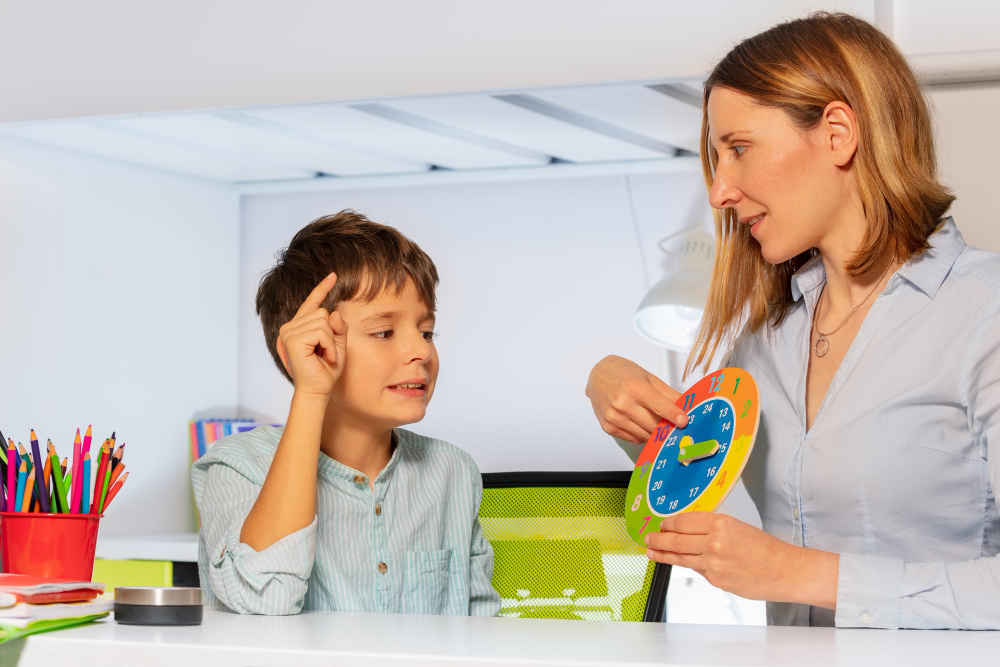
A child who is not talking as much as peers, or whose speech is hard to understand, can leave parents and educators unsure of what to do next. The daily environment, whether that is home, school, or a childcare setting, plays a significant role in how quickly a child with a speech delay progresses.
This guide is for parents and educators in Ahmedabad who want to understand what speech delay actually looks like, what practical strategies genuinely help, and when it is time to involve a speech therapist.
What Does Speech Delay Look Like?
A speech delay means a child is developing spoken language more slowly than expected for their age. Most children follow a broadly predictable pattern:
- By 12 months: Babbling regularly, using a few consistent sounds or simple words.
- By 18 months: Around 10 to 20 single words used meaningfully.
- By 24 months: Combining two words, such as “more juice” or “daddy go.”
- By 3 years: Speaking in short sentences, understood by people outside the immediate family most of the time.
If a child is significantly behind these markers, or if they have lost words they previously had, a professional assessment is the right next step. The full picture of causes, signs, and treatment options is covered in our article on speech delay in children.
Why the Daily Environment Matters as Much as Therapy
Children do not learn language only during formal therapy sessions. They learn through every interaction across the entire day. Every mealtime, every walk to school, every shared book contributes to how much language input a child receives.
A child who spends several hours in an environment that consistently supports communication will progress faster than one whose therapy is limited to a single weekly session. This is why what happens in childcare and at home matters enormously.
Parents and educators do not need to become therapists. A few core principles applied consistently throughout the day make a genuine difference.
Practical Strategies That Actually Help
Narrate What Is Happening
“You are pouring the water. Now you are drinking it.” “You are building a tower. A tall tower. It fell down!”
Running commentary during everyday activities gives children a constant model of language connected to real objects and actions. The child does not need to respond. The input itself is what matters.
Pause and Wait
After asking a question or making a comment, stop and count silently to ten before stepping in. Children with speech delays need more processing time than typical children. The pause is not awkward. it is necessary.
Accept any communication attempt: a point, a reach, eye contact, a sound. Respond to it as if it were a complete message. This teaches the child that communication works.
Expand What the Child Says
When a child produces a word or phrase, repeat it back with one more word added. Child says “dog” — you say “big dog” or “dog running.” Child says “want juice” — you say “you want more juice.”
This technique, called expansion, gives the child a slightly more complex model without putting them under pressure to produce it.
Recast Instead of Correcting
“No, say it properly” creates anxiety and reduces willingness to try. Instead, repeat what the child said correctly in your natural response. Child says “I goed to park” — you say “you went to the park, that sounds fun.”
The child hears the correct form without feeling criticised. Over time, this shapes speech naturally.
Read Together Every Day
Even 10 minutes of shared book reading daily builds vocabulary and comprehension faster than almost any other activity. Point at pictures, name what you see, ask simple questions, and follow the child’s gaze.
Choose books with clear pictures and simple, repetitive text. Let the child turn the pages and lead.
Create Reasons to Communicate
When adults anticipate every need before a child has to ask, they remove the communicative pressure that motivates speech. Offer choices: hold up two items and wait. Put a favourite toy slightly out of reach and wait. Pour a small amount of juice and wait for a request.
These moments, done without stress, give children a genuine reason to communicate.
Limit Passive Screen Time
Language is learned through back-and-forth interaction with a real person who responds to the child’s specific attempts. Passive screen time cannot replicate this, regardless of how educational the content is.
What Educators Can Do in a Childcare or School Setting
All of the strategies above apply equally in childcare and school settings. Additionally, educators can:
- Document specific observations: Not “Priya doesn’t talk much” but “Priya used fewer than five words during group time today and communicated mainly by pointing.” Specific examples are useful for families and for therapists.
- Pair children strategically: A child with a speech delay placed alongside a communicative peer during play naturally hears more language modelled in a low-pressure context.
- Use visual supports: Picture cards for common items, a visual daily schedule, and gesture cues alongside spoken language help children process and produce language more successfully.
- Talk with families: Share observations sensitively. Start with something positive, then raise concerns as a question: “I’ve noticed Riya tends to point more than speak at school. How is she communicating at home?”
When to Seek Professional Speech Therapy
Everyday strategies support development but they are not a substitute for professional assessment when it is needed. Seek a speech therapy assessment if:
- The child has no words by 16 months or no two-word combinations by 24 months
- The child has lost words or sounds they previously had
- Speech remains very hard to understand even for familiar adults by age 3
- The child shows significant frustration when trying to communicate
- There are hearing concerns or frequent ear infections
- Speech delay is accompanied by other developmental concerns such as limited eye contact or repetitive behaviour
7 Senses in Ahmedabad offers speech therapy for children from infancy through school age. Sessions are play-based and parent-inclusive. For families who want to understand what a therapist actually does in sessions, our article on speech therapy exercises covers specific techniques used both in clinic and at home.
What to Expect From Speech Therapy
For young children, speech therapy is almost entirely play-based. A therapist observes the child during play, uses structured activities targeting specific goals, and involves the parent in learning strategies to continue between sessions.
Sessions typically happen once or twice a week. The progress a child makes between sessions, through consistent home and school strategies, often matters as much as the sessions themselves.
For families outside Ahmedabad, or those who need flexibility, online consultation is also available.
Frequently Asked Questions
Q: Can a childcare worker or teacher support a child with speech delay without being a therapist?
Yes. The strategies in this guide are used by parents and educators effectively every day. The therapist’s role is to assess, set specific goals, and guide the approach. The caregiver’s role is to create a language-rich environment and apply those strategies consistently.
Q: My child speaks well at home but not at school. Is this a speech delay?
Not necessarily. Some children are naturally quieter in group settings or with unfamiliar adults. A speech delay affects communication across all settings, not just in specific environments. An assessment will clarify this.
Q: Does growing up with two languages cause speech delay?
No. Bilingual children may reach milestones in individual languages slightly later than monolingual peers, but their total communication across both languages should be on track. A therapist experienced with bilingual children can assess this accurately.
Q: How long before we see results from speech therapy?
This depends on the child’s starting point and how consistently strategies are applied at home. Many families notice changes within 8 to 12 weeks of consistent therapy combined with daily home practice.
Q: Is speech therapy available in Ahmedabad for very young children?
Yes. Speech therapy can begin as early as infancy. Early intervention consistently produces better outcomes than waiting.
Conclusion
Every interaction a child has with a caring adult is a language learning opportunity. Parents and educators in Ahmedabad who understand a few consistent principles make a genuine difference to how quickly a child with a speech delay progresses.
If you have concerns about a child’s speech and would like a professional assessment, contact 7 Senses in Ahmedabad.